SWITCH
To characterize the fortnightly switching of residual flow drivers in poorly described estuaries
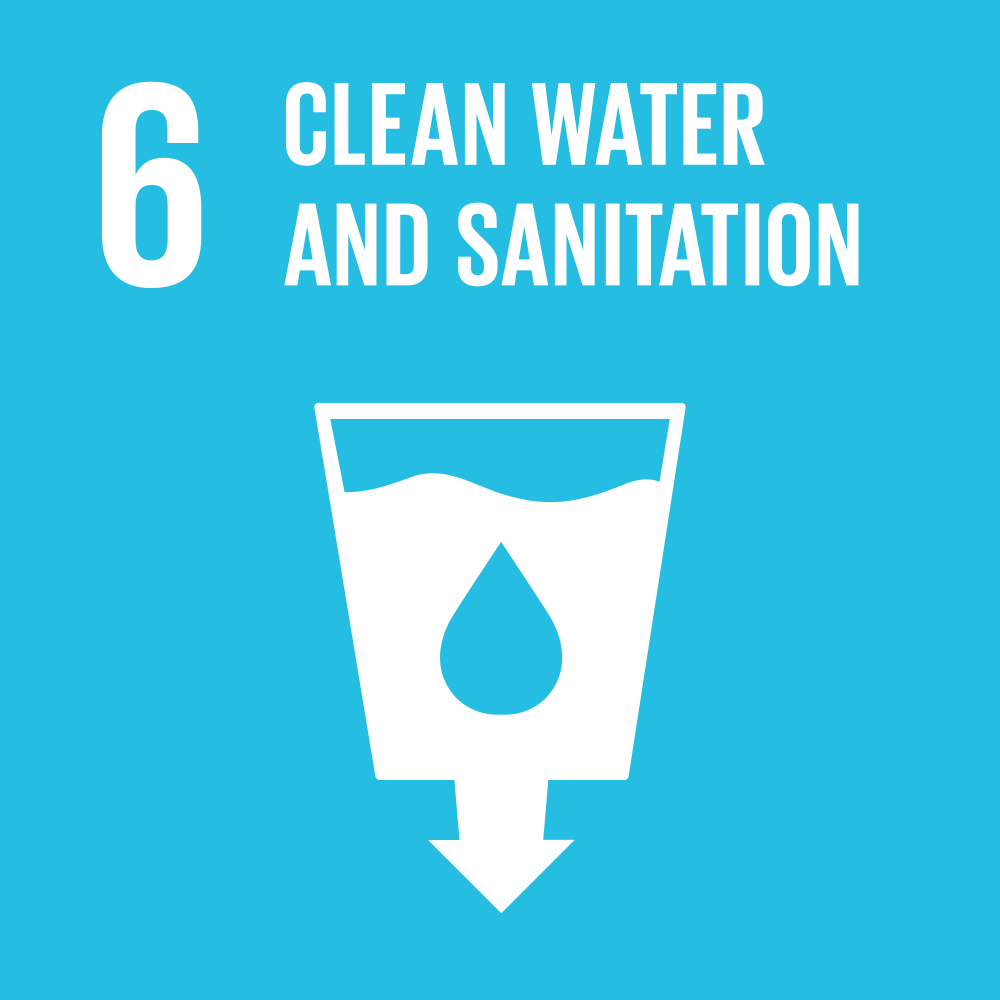
SWITCH is a science project exploring the generation of residual flows in estuaries. This circulation controls the net transport of biologically and chemically important material (such as nutrients, contaminants and salt), and is therefore of uttermost importance with respect to water management and ecosystem health. Through an increased knowledge of the competition between residual flow drivers, the project will directly contribute to Sustainable Development Goals (SDG) 14 (“To conserve and sustainably use the oceans, seas and marine resources for sustainable development”), in particular Target 14a (“To increase scientific knowledge and develop research capacity”). Furthermore, the project will ultimately result in a new classification of estuaries based on hydrodynamic parameters. Such classification is more suitable to represent long-term transport processes in comparison with previous classifications. It will therefore constitute an improved tool for the support of freshwater management activities related to saltwater intrusion along estuarine channels. In that respect, SWITCH will contribute to SDG6 (“To ensure availability and sustainable management of water and sanitation for all”), in particular Target 6.4 (“By 2030, substantially increase water-use efficiency across all sectors and ensure sustainable withdrawals and supply of freshwater to address water scarcity and substantially reduce the number of people suffering from water scarcity”) and Target 6.5 (“By 2030, implement integrated water resources management at all levels, including through transboundary cooperation as appropriate”). At the case study (which constitutes the southern border between Spain and Portugal), salt intrusion is a topic of growing concern, which is in the agenda of various public and private institutions. SDG6 will be specifically addressed through stakeholders’ involvement for the establishment of adapted freshwater management practices. Additionally, the project results will be a springboard for future proposals dedicated to the transboundary management of the freshwater supply (Target 6.5).
FCT I.P.
Sobre
Residual currents in estuaries correspond to the average result of one or more tidal cycles. They control the circulation of dissolved and suspended material and the intrusion of salinity into estuaries. Their knowledge is therefore extremely important for water quality management and the study of ecological processes.
According to the knowledge acquired in the large estuaries of temperate latitudes, it is assumed that the residual circulation is mainly dominated by horizontal density gradients. In this project, we will determine the circumstances in which the residual circulation in estuaries changes from being baroclinic (due to density) to barotropic (due to the tide). This change in forcing mechanism can induce a reversal in the residual circulation and therefore affect long-term transport processes. The study will test the hypothesis that this switch can be determined with a non-dimensional number: the internal Froude tide number, Fr0.
Studies carried out in temperate estuaries - where residual currents are dominated by baroclinic forcing mechanisms - have shown that maximum residual flows occur during low tides. In contrast, research in subtropical estuaries, dominated by tidal forcing, shows that the maximum residual currents occur during high tides. Therefore, the magnitude of the residual currents can vary between dead and high tides, but their direction (upstream or downstream) and their distribution across the channel remain constant.
Partners: Arnoldo Valle-Levinson (University of Florida), Maitane Olabarrieta (University of Florida), Alejandro López-Ruiz (University of Seville), Ana Ramos (Centro de Ciência Viva de Tavira), André Fortunato (National Laboratory of Civil Engineering - LNEC, Lisbon), Manual Diez-Minguito, University of Granada