What does coastal resilience mean?
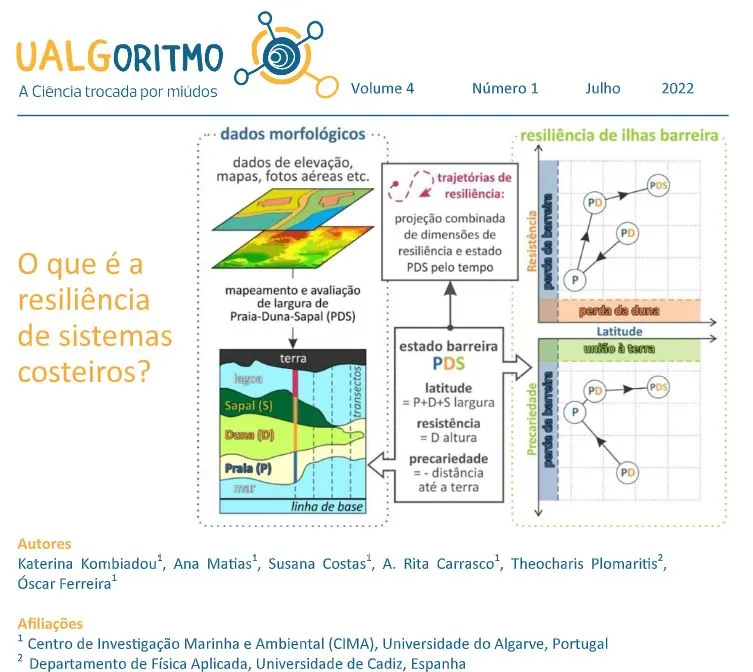
CIMA researchers Katerina Kombiadou, Ana Matias, Susana Costas, A. Rita Carrasco, Theocharis Plomaritis and Óscar Ferreira published their work on coastal resilience in Vol 4(1) of Ualgoritmo. The science communication paper was reviewed by Guilherme Guerreiro, Gustavo Almeida, Gustavo Fernandez and João Castro, students of the Loule Secondary School, under the guidance of Professor Paula Ribeiro.
Ualgoritmo Publication
Resilience of natural systems has been recently receiving increased attention due to its importance for achieving sustainability, especially in face of climate change. However, the term is often been used vaguely and with different intentions, leading to misinterpretations and confusion. More often than not, resilience is conceived as a perspective, rather than a clear and well-defined concept. For coastal systems, resilience can be even more difficult to define, as it is mainly viewed from a human perspective, focusing on the maintaining the services coastal systems provide (i.e., storm protection), rather than the sustainability of the coastal system itself. In this work we attempt to clarify resilience principles, to link resilience and adaptation with morphological dimensions and to provide means to quantitatively assess coastal resilience.
The LIFE Ilhas Barreira project introduces you to one of the seabirds breeding in the coasts of Ria Formosa: the Little Tern (Sternula albifrons). Check out this beautiful animation and learn more about these intrepid seabirds and how you can help us to protect them!
The LIFE Ilhas Barreira project

keep the distance

be careful to not step on eggs or baby birds

keep your dog away from the exclusion area

use the walkways

respect the warnings
SPEA - Sociedade Portuguesa para o Estudo das Aves
Instituto da Conservação da Natureza e das Florestas
Centro de Ciencias do Mar (CCMAR)
This an informal education activity focusing on coastal dynamics designed for 10-year-old students. It combines coastal science concepts (wind, waves, currents, and sand), storytelling techniques (narrative arc), and creative dance techniques (movement, imaginative play, and sensory engagement). A sequence of six exercises is made, starting with the generation of offshore ocean waves and ending with sediment transport on the beach during storm/fair-weather conditions. Scientific concepts are translated into structured creative movements, within imaginary scenarios, and accompanied by sounds or music. The activity was carried out in collaboration with Ciência Viva de Tavira, on 6 occasions, with a total of 112 students.
Science & art activity: ‘The sea rolls the sand’

© 2017 Ana Matias

© 2017 Ana Matias
This activity was developed within the outreach tasks of the project EVREST – Evolution and Resilience of Barrier Systems (more info here) - PTDC/MAREST/1031/2014, funded by Fundação para a Ciência e a Tecnologia.
For more informations about this projet, please visit: https://evrest.cvtavira.pt/. Results from the development and evaluation of this activity can be found here: https://gc.copernicus.org/articles/3/167/2020/