CIMA aims to strengthen its leadership in marine and environmental science and technology by leading the way in cutting-edge, innovative and high-quality research. This involves strengthening its capabilities in innovation, internationalisation, training, industrial/institutional partnerships, literacy, and open science. CIMA will address this challenge through a comprehensive RTMD approach: Research (both fundamental and applied), Tools (development, testing, and validation), Management (implementing best practices and solutions), and Dissemination (to stakeholders and society). The products, data, and publications developed will adhere to an open-access and open-source policy. CIMA will apply the above integrative approach in the new digital environments to address the European Commission Societal Challenges and United Nations Sustainable Development Goals, namely scientific issues related to Ocean and Coastal Dynamics and Environmental Systems and their resources.
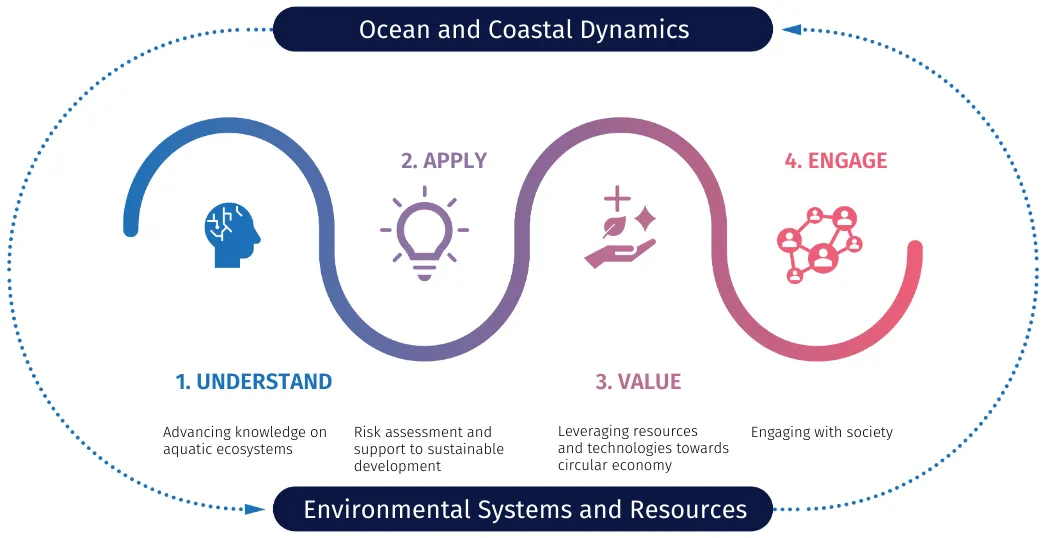
The Strategic Project for 2025-2029 adopts a holistic approach to ensure the sustainability and effective management of marine and environmental systems, and comprises four strategic objectives, three of which mainly scientific and one more social, that will operationalize the scientific areas:
-
Objective 1 –Understand focuses on understanding and monitoring stressors on aquatic ecosystems, including sources of pollutants and their connection to climate, in line with the challenges outlined in the UN Ocean Decade.
-
Objective 2 – Apply seeks to reduce vulnerability and increase resilience using sustainable solutions, such as nature-based solutions.
-
Objective 3 – Value focuses on the implementation of circular economy strategies to promote sustainable resource use, emphasizing interdisciplinary innovation.
-
Objective 4 – Engage addresses public engagement in the dissemination of scientific knowledge.
Strategic objective 1 aims to understand the impact of multiple stressors on marine and coastal ecosystems, identify the sources of land-based and marine old and emerging pollutants and contaminants, understand the ocean-climate link for a sustainable future, establish a sustainable ocean observing system that provides accessible, timely, and actionable data and information, and develop a comprehensive digital map of the ocean. It also includes the use of ocean observing systems and innovative coastal tools to document environmental change, to unravel the effects of climate change at different scales of analysis, to expand global ocean observations, and to improve the digital representation of the ocean. The following are the main tasks to be developed under this objective.
- Task 1.1 Conduct comprehensive research on aquatic ecosystems
-
This task aims to generate interdisciplinary knowledge on oceanic and coastal processes to improve the understanding of the impact of natural and human stressors on the dynamics of marine and coastal systems. The main activities to be developed are:
- Investigate the impact of multiple environmental drivers on marine and coastal processes, including ocean circulation, thermal expansion, hydrogeochemical interactions, microbial processes and food webs, at different temporal and spatial scales;
- Combine field, experimental, and modelling approaches with innovative methods, such as numerical modelling, remote sensing and artificial intelligence, to collect and extract high-quality (and high-resolution) environmental data for improved ocean observing systems and for the development of coastal management tools.
- Task 1.2 Apply socio-ecological frameworks in aquatic ecosystems
-
Ao abranger os aspetos físicos, biológicos, sociais e económicos identificados no objetivo 1, o objetivo estratégico 2 visa quantificar os impactos das alterações climáticas e de outros fatores de pressão antropogénicos nos sistemas naturais, através da avaliação da vulnerabilidade dos oceanos e das costas e da proposição de soluções sustentáveis. Promoverá ativamente o desenvolvimento de ecossistemas resilientes às alterações climáticas (e de abordagens baseadas na natureza) para a adaptação às alterações climáticas, desempenhando, em última análise, um papel fundamental na promoção da conservação da biodiversidade e na melhoria do bem-estar humano. Seguem-se as principais tarefas a desenvolver no âmbito deste objetivo:
- Identificar limiares ambientais e avaliar a resiliência;
- Desenvolver vias de mitigação e adaptação.
Objective 1 – Advancing Knowledge in Aquatic Ecosystems Dynamics
By encompassing the physical, biological, social, and economic aspects identified in objective 1, strategic objective 2 aims to quantify the impacts of climate change and other anthropogenic stressors on natural systems, by assessing the vulnerability of oceans and coasts and providing sustainable solutions. It will actively promote the development of climate-resilient ecosystems (and nature-based approaches) for climate adaptation, ultimately playing a pivotal role in promoting biodiversity conservation and enhancing human well-being. The following are the main tasks to be developed under this objective.
- Task 2.1 Identify environmental thresholds and assess resilience
-
Task 2.1 Identify environmental thresholds and assess resilience
This task aims to generate state-of-the-art knowledge on risk assessment in natural and human environments. The following are the main activities that will be developed:- Assess and predict risks associated with marine hazards, such as pollution, eutrophication, storms, rising sea level, and harmful algal blooms, by developing probabilistic methods and models;
- Identify thresholds for assessing the resilience and adaptation of marine and coastal systems in response to a range of environmental perturbations;
- Evaluate potential health risks arising from disturbances in marine and estuarine ecosystems
- Task 2.2 Develop mitigation and adaptation pathways
-
This task represents a major step forward in the application of knowledge to develop optimal strategies for coping with global change and human pressures. It will provide fundamental knowledge to support the formulation of science-policy approaches. The following activities are envisaged:
- Design comprehensive pathways for robust decision-making, with trade-offs and synergies, to enhance ecosystem and community resilience through preparedness measures and transformative change;
- Provide evidence-based research on nature-based strategies for mitigation, adaptation, disaster risk reduction, biodiversity, conservation, and sustainable management of natural resources.
Objective 2. Risk Assessment and support to Sustainable Development
Strategic objective 3 involves the implementation of techniques and optimisation strategies within a circular economy framework for the sustainable use and valuation of biological, inorganic, and energy resources. An interdisciplinary approach will be taken to develop novel treatments, processes, and solutions to reduce waste, recover water resources, produce renewable energy, and maximise resource efficiency. The tasks within this objective are as follows:
- Task 3.1 Re-purpose resources for sustainable use
-
This task aims to identify and characterise natural or by-product renewable resources and to test and implement innovative approaches for their sustainable use. This task will include the following activities:
- Improve methods and molecular tools to evaluate the sustainability potential and repurposing of biological resources;
- Explore the use of agro-industrial and marine by-products to discover new and sustainable biotechnological resources;
- Implement biotechnological processes for urban water recovery, carbon sequestration in wastewater treatment, and removal of emerging contaminants and nanoplastics from aquatic systems.
- Task 3.2 Improve Blue and Green Energy Systems
-
This task aims to expand CIMA's work on renewable energy sources, including alternative biofuels, marine energy, and renewable energy communities. It contributes to the adoption of environmentally friendly technologies to reduce carbon emissions (blue technologies) and preserve natural resources (green technologies). This task will focus on the following activities:
- Improve biorefinery systems using biological resources identified in task 3.1 to produce alternative biofuels and added value to by-products while minimizing effluents, waste, and emissions;
- Improve marine renewable energy technologies for wave and offshore wind resources is essential to increase their reliability as energy converters and their effective contribution as energy production systems;
- Research smart grids and energy demand response mechanisms to create renewable energy communities that contribute to the use of local energy resources.
Objective 3. Leveraging resources and technologies towards circular economy
This objective aims to engage with society by sharing research findings, participating in executive and advisory boards, building partnerships with the public and private sectors, and enhancing capacity building. The following are the main tasks to be developed under this objective:
- Task 4.1. Reinforce collaborations with institutions and civil society
-
This task aims to develop and strengthen collaborations with stakeholders, based on the knowledge generated under strategic objectives 1 to 3. The following are the main activities to be developed:
- Maintain a high-level of participation in executive and advisory bodies of various international committees and organisations (e.g., UNESCO Decade for Science of Ocean Sustainability and European Space Agency);
- Develop and strengthen partnerships with regional and national authorities to support informed decision-making on environmental strategies, planning, and management while improving the science-policy-society interface;
- Consolidate CIMA’s role in the associative laboratory ARNET and S2Aqua collaborative laboratory.
- Task 4.2. Promote Science communication and training
-
This task aims to provide scientific knowledge and technical know-how for society. The following are the main activities to be developed:
- Activities to promote science literacy through interactive engagement between academia, schools and other audiences, thereby fostering a commitment to blue sustainability and ecological stewardship;
- Online science communication, including social media, and participation in face-to-face activities to share the knowledge, people, and tools of CIMA’s scientific research with different audiences;
- Life-long training in CIMA’s scientific areas for school teachers and other professionals;
- Involving the community in the creation, maintenance, and evaluation of open science, supporting their establishment and maintenance.